You're scrolling through your broker app on a random Tuesday when you land on the options chain. Rows of calls and puts. Strike prices ticking up and down. Numbers flashing every few seconds like a slot machine that forgot to make noise. A friend tells you to "just buy a call, it'll 3x if the market moves your way." Somewhere in the back of your head, a quieter voice asks a different question: wait, why does this even exist? Who looked at the stock market one day and decided it needed side bets bolted onto it?
That question is more reasonable than it sounds, and the honest answer has almost nothing to do with 3x-ing anything.
Why Do Options Actually Exist?
Options exist so someone can lock in a price today for something that might happen later, without being forced to commit to it fully. That's the whole reason. Everything else people associate with options (the leverage, the fast money, the "turned ₹200 into ₹2,000" screenshots) is a side effect of that original purpose, not the purpose itself.
Key takeaway
Options were built to let people transfer risk: pay a small, known cost now to protect against (or bet on) a bigger, uncertain outcome later. Speculation is what makes that transfer cheap and liquid. It was never the reason the instrument was invented.
Wait, This Is 2,500 Years Old?
Here's the part that surprises most people: options aren't a Wall Street invention from the 1970s, and they weren't cooked up by an exchange to keep retail traders busy. The core idea is genuinely ancient, and it keeps resurfacing independently across very different times and places, which is usually a sign that it's solving a real problem rather than chasing a fashionable one.
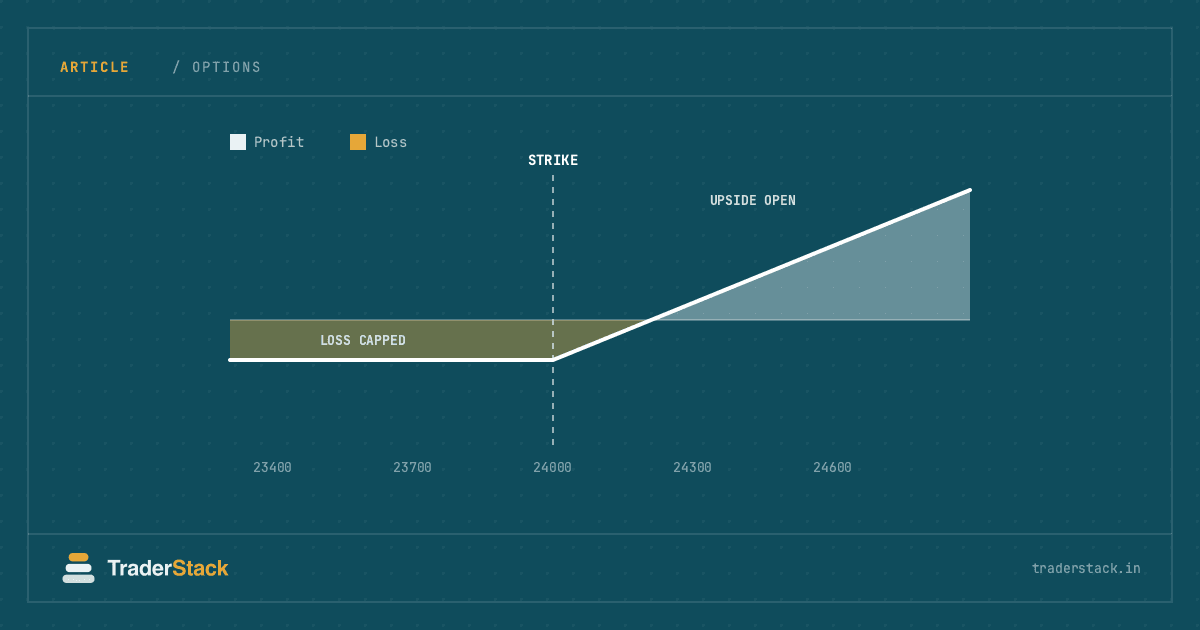
The earliest recorded version comes from ancient Greece. According to Aristotle, a philosopher named Thales had studied the weather closely enough one winter to guess that the coming olive harvest would be unusually large. Everyone else was still uncertain, so olive-press owners around Miletus were happy to take a small deposit from him for the right, not the obligation, to rent their presses at a fixed rate once harvest season arrived. If Thales had been wrong and the crop had failed, he would have simply walked away from the right he'd paid for, losing only that small deposit. He wasn't wrong. When the bumper harvest came in and every farmer suddenly needed a press, Thales was the one holding the reservations, and he rented them out at whatever rate the sudden demand allowed. Strip away the trading app and the candlestick chart, and that's a call option wearing a toga: a small, known cost paid upfront for the right to profit from an uncertain event later, with the loss capped at that upfront cost if the bet doesn't pay off.
The idea keeps resurfacing after that, in places that had no contact with each other. Merchants in medieval Europe struck forward deals on wool and grain years before it ever reached a market. By the 1730s, rice traders in Osaka were running the Dojima Rice Exchange, a formal market where you could buy the right to a future rice price months ahead of the actual harvest, centuries before Mumbai or Chicago had anything resembling a derivatives exchange. Farmers, traders, and merchants kept reinventing this same basic shape for one plain reason: uncertainty about the future has never been a new problem, only a recurring one.
What none of these earlier versions had was a standardized, exchange-listed contract that a total stranger could trade with confidence. The NSE only started listing standardized options in the early 2000s. Everything before that was two parties shaking hands on a private deal, trusting each other (or a local guild) to actually honor it. The exchange didn't invent risk transfer. It just made the idea liquid, regulated, and available to anyone with a demat account, instead of anyone with the right connections.
Who Actually Guarantees the Other Side Pays Up?
Here's the part those old private deals never fully solved. If Thales's harvest bet had gone bad enough that an olive-press owner refused to honor it, his only recourse was reputation, a local guild, or a genuinely awkward argument. A private contract is only as good as the person standing on the other side of it.
This is the part a modern exchange actually fixes, and it has nothing to do with speculation. When you buy a put option through your broker today, you aren't trusting the specific stranger who sold it to you. You're trusting the exchange's clearing corporation, an entity that inserts itself into every single trade and becomes the buyer to every seller and the seller to every buyer. It collects margin from both sides upfront, precisely so that if one side can't pay, the clearing corporation still can. You could sell an option to someone on the other side of the country and never learn their name, and the contract would still get honored exactly as written.
That's the second thing the "modern" version of this ancient idea actually added. Not the concept of risk transfer itself, which is 2,500 years old, but a guarantee that makes it safe to do with a total stranger instead of only with people you already trust.
Let's See It Play Out
Say you're a long-term equity investor in Pune. You've built a ₹2,00,000 portfolio of large-cap stocks over a few years, and you're not interested in day-trading any of it. Union Budget day is next week, and you have a bad feeling about it. Selling everything is one option, but it isn't free: STT, brokerage, and other charges on the sell side alone could run you somewhere in the ₹300–400 range on a portfolio that size, on top of triggering capital gains tax on the profits and losing a holding period clock you've spent years building. And if the Budget turns out to be a non-event, you'd have to buy everything back at whatever the new price happens to be. None of that is enormous money, but it's real friction, the kind that makes "just sell and rebuy" a worse plan than it sounds.
This is exactly the gap options were built to fill. Instead of selling your portfolio, you buy a Nifty put option, a contract that gives you the right to sell at a fixed level without obligating you to. Nifty is trading around 24,000. You buy a 23,800 put for a premium of ₹150. Nifty's lot size is 65 at the time of writing (check the live figure before trading, since NSE revises it periodically), so one lot costs you 150 × 65 = ₹9,750.
If Budget day goes badly and Nifty drops to 23,200, your put gains roughly what your portfolio lost. You've hedged the damage for the cost of one lot, and you still own every stock you started with, holding period and all. If Budget day turns out to be a non-event and Nifty holds steady, you lose the ₹9,750, the same way you'd lose a car insurance premium in a year you didn't crash. That's not the strategy failing. That's the strategy working exactly as designed: you paid a known, small amount to cap an unknown, larger one.
What People Get Wrong About This
Options exist so retail traders can gamble with big leverage on Bank Nifty.
Options exist so people can transfer risk cheaply. Leverage-driven speculation is a side effect that supplies the liquidity making that transfer possible.
If nothing bad happens by expiry, buying that put was a waste of ₹9,750.
The put did its job the moment it existed, by removing the uncertainty for the week you held it. Nobody calls a car insurance premium wasted money just because they didn't crash that year.
Here's the part that actually reconciles the "casino" feeling with the "insurance" explanation: they're not in tension. The Pune investor above needs someone on the other side of that put trade: someone willing to sell it, take the opposite view, and get paid for carrying that risk. In practice, a large share of that other-side liquidity comes from traders using leverage to take short-term directional positions, which is the exact "gambling" behavior that makes people suspicious of options in the first place.
Without that speculative volume, the market for options would be thin. Spreads would be wide, fills would be unreliable, and hedging would get expensive fast, closer to negotiating a private contract with a stranger than clicking "buy" on an app. That speculative volume is exactly what keeps the instrument liquid enough to actually use for the reason it was built in the first place.
Where to Go From Here
Knowing why options exist doesn't tell you how a call and a put actually behave once the price starts moving: who profits, who's on the hook, and what "a right without an obligation" actually costs in practice. That's the next real step.